

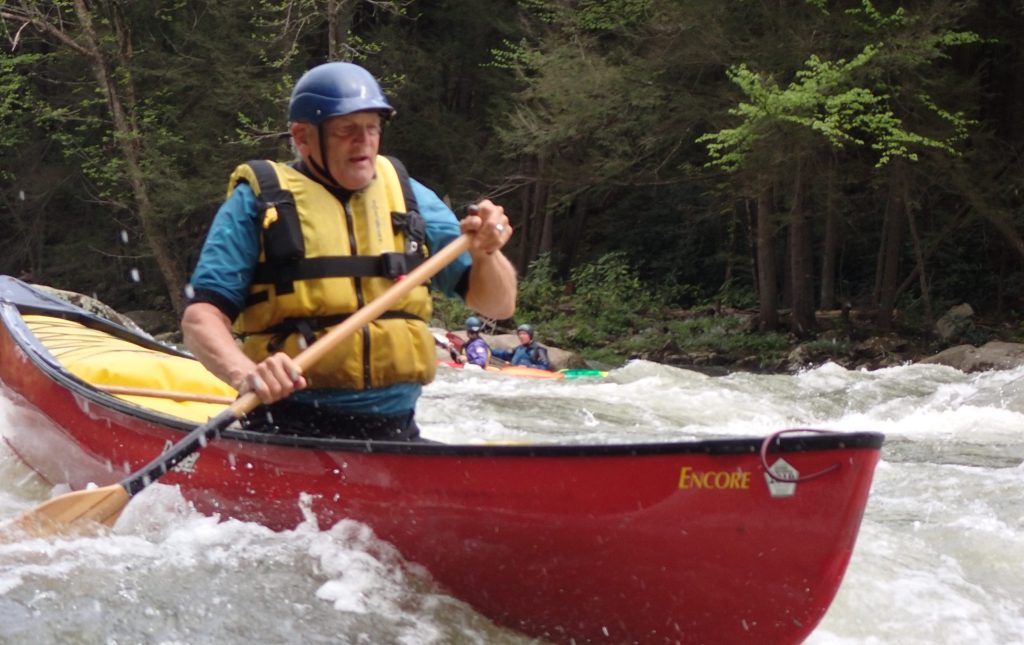
It started back in 1959, at a summer camp in New Hampshire. Camp Mowglis introduced me to the outdoors and, as a counselor, to taking responsibility for the safety of my group. The “Accidents” section of Appalachia magazine was part of my education. As I progressed from “junior assistant” to “senior leader” over the next ten summers, I enjoyed leading “my boys” in the mountains. The accident reports reinforced the procedures I was following and made me aware of things that could go wrong. I learned to canoe at the camp and later ran the first whitewater program there.
In 1966, I entered Bucknell University in central Pennsylvania. Since the college didn’t have an outing club, my roommate Marty Pickands and I started one. The club was totally student-run. We had faculty advisors, but they were pretty hands-off. There were trails to hike, rocks to climb, caves to explore, and rivers to run. That spring, Marty—who had been a counselor at a canoeing camp—invited me on an overnight trip down Penn’s Creek. I was entranced by this beautiful river! Its narrow mountain valley had gorgeous scenery and the rapids were exciting. None of us wore life vests and our skills were pretty marginal, but the water level was low and, except for a few minor mishaps, the trip went smoothly.
Over the next few years, we explored the area’s Class I–II streams in aluminum canoes. Gas station maps showing roads and rivers served as our guidebooks. John Urban’s Whitewater Handbook for Canoe and Kayak taught us the basics of water reading and some important safety precautions. We bought life vests and avoided major mishaps. I was hooked! One day, we were running the Loyalsock River when a slalom race was underway. Those kayaks looked amazing! We all got kayaks and started learning how to paddle them. Learning to roll a kayak from the stick-figure drawings in the Whitewater Handbook was pretty challenging. Since the Loyalsock Race was run by the Penn State Outing Club, I wrote them asking for help. I got a reply from John R. Sweet inviting us to their pool sessions.
The Penn State pool sessions brought together a varied group of paddlers: students, faculty, State College residents, Boy Scouts from nearby Bellefonte, and three of us from Bucknell—an hour away. Sweet and several others were nationally ranked ACA racers, and their skills were impressive. They were also helpful and generous coaches. Through them, we learned how to build fiberglass kayaks, rented a mold, and made a few kayaks ourselves. Those pool sessions introduced me to the whitewater community, which back then was centered around slalom racing. Paddlers of all abilities raced, usually in the same boats they used to run rivers. Everyone helped put on the races by hanging gates, judging the runs, and taking down the course afterward.
After graduation, I moved to the Washington, D.C., area—home of the Potomac River and the Canoe Cruisers Association, a large, active paddling club. I began my introduction to West Virginia rivers with a run down the Gauley in 1971. I only swam twice!
A year later, I had a business idea. Back then, most paddling gear was homemade, and it was often difficult to find all the materials needed. I created spray skirt, life vest, wetsuit, and paddle jacket kits and sold them by mail. This business gave me a lot of freedom to paddle. I traveled south and ran many of the harder rivers in the Smokies and Tennessee Plateau. I guided rafts in North Carolina, worked weekends on the Cheat River in West Virginia, and continued to race slalom and downriver. I joined the ACA so I could enter Nationals. Although I usually paddled with young, aggressive paddlers, our slalom skills and a respectful attitude kept us out of trouble.
In October 1975, I was at the Icebreaker Slalom near Unadilla, NY—an easy-going Class II race on a small creek below East Sidney Dam. It was an opportunity for racers to hang out together before winter came. I was paddling the course on a practice run when, looking downstream, I realized that something was wrong. A hundred yards downriver, at a small ledge, there were ropes in the water and people running around on shore. I landed, ran up, and saw that someone was trapped underwater. No one knew what had happened, and we didn’t know what to do. Finally, the dam cut off the water, and we were able to pull him from the river. They administered CPR, but he had been underwater much too long.
Deaths among experienced, well-equipped whitewater paddlers are quite rare, and this one really shocked me. It was the last thing I expected at a Class II novice slalom! People said it was a “freak accident,” but I wasn’t satisfied. I spoke with several witnesses and learned that the man was paddling a C2 when his boat flipped. His partner swam to shore, but he held on. He stood up in the river and tried to walk the boat to shore. When he washed over the ledge, his foot went under a large underwater rock. The current pushed him downstream and pulled his head underwater. He was trapped, and no one could help.
Determined to tell what happened, I wrote a report that was published in the American Whitewater Journal. It turned out to be the first widely published description of a foot entrapment. Because of this and another report, I was asked by Chuck Tummonds, the American Canoe Association Commodore, to serve as ACA Safety Chair in 1977.
Chuck led an outreach to the U.S. Coast Guard which, thanks to the National Safe Boating Act of 1971, was planning to regulate non-powered boat safety. Although they were experienced with large boats on open water, they didn’t understand small paddlecraft. They wanted to require “level flotation” to be installed in all open canoes to create a “stable rescue platform” in the event of a capsizing, so paddlers could wait for help. While this innovation worked with powerboats, it wasn’t practical in canoes.
Representatives from the ACA, American Whitewater, the U.S. Canoe Association, and several canoe manufacturers met with the Coast Guard in Washington, D.C. It was a rather testy gathering. Although they had an “independent study” suggesting level flotation could save dozens of lives each year, none of us knew of any accidents where it would have helped. We returned as a group to study three years of accident reports, replicating their study. About 10% of accidents were not witnessed, and we listed them as “unable to determine cause.” Coincidentally, this was roughly the percentage of accidents their study claimed would be helped by level flotation. With canoes and kayaks, equipment is no substitute for skill and judgment. Our final report emphasized the need for “Education, Not Regulation” and the wider use of life vests.
Around this time, I was asked to serve on the ACA Instruction Committee, which was helping the American Red Cross update its canoe and kayak training program. Back then, they were the nation’s largest providers of small craft training. Ray Miller was their all-around small craft expert, and we worked closely with him. We helped produce a textbook and three whitewater safety films. Later, the ACA developed its own instruction program—fortunate timing, as the Red Cross abruptly discontinued its small craft safety instruction program a few years later.
Ray also shared a drawing of a throw-line rescue bag, which he had found in U.S. Navy archives. It was standard equipment on lifeboats during World War II. I was one of the few whitewater paddlers who carried a rope back then, but it took a long time to uncoil and prepare for use. Rescue bags made the rope instantly available, and I started manufacturing them as part of my business. Now they are standard equipment for river runners.
In the early 1980s, the ACA connected me to the Pennsylvania Fish and Boat Commission, which regulated boating in my home state. They were also trying to train their conservation officers to handle moving water. Through them, I became aware of many accidents involving inexperienced paddlers—and of how untrained first responders were getting into trouble trying to help them. These incidents led some politicians to push for restrictions on river access. A similar program was underway in Ohio through their Division of Watercraft, and I was able to help out there as well. Eventually, swiftwater rescue training was offered to firefighters in both states.
As whitewater sport grew, safety issues developed on both the Potomac River near Washington D.C. and the James River in Richmond, Virginia. There were some high-profile deaths and rescues on both rivers. First responders, who had little contact with skilled paddlers—who usually take good care of themselves—mistakenly believed all paddlers were like the untrained individuals they were rescuing. Again, there were calls for river access restrictions. I worked with the ACA and local paddling clubs to organize River Safety Symposiums on both rivers, bringing paddlers and rescue professionals together to share knowledge. We had help from boating safety trainers from Ohio and Pennsylvania, which added credibility and expertise. Today, fire companies on both rivers have strong, well-equipped, and well-trained river rescue teams.
I continued collecting and reporting on accidents based on information sent in by individual members of the paddling community. Reports were initially submitted via mail or phone calls. By the early ’90s, email became the primary means of communication, and in the last decade most contacts have come in through Facebook Messenger. Since most paddling groups nationwide have Facebook pages, it’s easy to reach out and gather more details.
Accounts of accidents involving inexperienced paddlers usually come from newspaper articles or online press releases from first responders. This information is sometimes sketchy, but I supplement it by talking to local paddlers. For accidents within the paddling community, I try to correspond directly with witnesses. When I prepare a report, I send it to those involved for corrections and additions. It’s their story, and I want to get it right.
Talking about accidents isn’t easy—it often stirs up powerful emotions. Friends and family are sometimes upset by these discussions, and online commentary can be remarkably insensitive and hurtful. I encourage people to tell their stories to help quell internet rumors and help the community learn from tragic events. I try to be matter-of-fact when describing what happened, so the story delivers the message without sounding preachy. While working with the ACA, we published four editions of the River Safety Reports, small books compiling several years of these accounts.
Accident reports have influenced our choice of gear and outfitting, warned us about dangerous river features, and helped us develop safer on-water habits. They remind us to be cautious and vigilant. But perhaps their greatest impact has been on the evolution of swiftwater rescue skills.
After the death of a fellow guide on the Chattooga River in 1979, Les Bechdel and Slim Ray spent the winter developing techniques that could have made a difference. The following year, they held their first rescue classes. One of their techniques—the stabilization line—might have made rescue possible at the Icebreaker Slalom. Other skills followed.
A few years later, influenced by my river guiding experience, I began teaching a “Whitewater Self-Defense” course on the Delaware River. It focused on swimming, wading, and throw bag skills. I wanted to help people feel comfortable working outside their boats and in moving water. In 1989, at the request of ACA Commodore Merle Garvis, I partnered with Wayne Sundmacher to combine the best features from several programs and create the ACA Swiftwater Rescue Course. It has since grown to include hundreds of instructors and thousands of students. Wayne and I co-authored the Whitewater Rescue Manual to support the course. Sadly, it’s now out of print.
It’s been fascinating to watch whitewater sports evolve over the past fifty years. Homemade boats and gear have given way to an incredible diversity of paddlecraft. While canoe use has declined, packrafts, stand-up paddleboards, and small inflatables of every shape and size now fill our rivers.
Unfortunately, there has also been a dramatic rise in recreational kayaking accidents. Many of these boats are inexpensive products sold in big-box stores. Their buyers aren’t necessarily looking for adventure—and they’re getting no guidance. They typically don’t wear life vests and aren’t prepared to deal with the hazards of even mild current. Capsizing, downed trees, and low-head dams take their toll.
Reaching out and offering even a little training or knowledge is a real challenge—but it’s also more important than ever.
The ACA extends our deepest gratitude to Charles “Charlie” Walbridge for sharing “A Whitewater Safety Journey” with the ACA Story Project and for his decades of service to the paddling community. His dedication to documenting incidents, improving instruction, and advancing whitewater safety has helped save countless lives and shape the way paddlers and professionals approach risk on the water.
About the Author
Charlie Walbridge is a Lifetime Member of the American Canoe Association, first joining in 1973. For over 30 years, he has collected and published reports on U.S. whitewater fatalities, becoming a nationally recognized expert in whitewater safety. A prolific writer, Charlie has authored numerous books and articles on the subject and has served as an expert witness in many wrongful death cases. Charlie has held key leadership roles in both the American Canoe Association and American Whitewater and helped develop nationally recognized programs in whitewater canoeing and swiftwater rescue.