

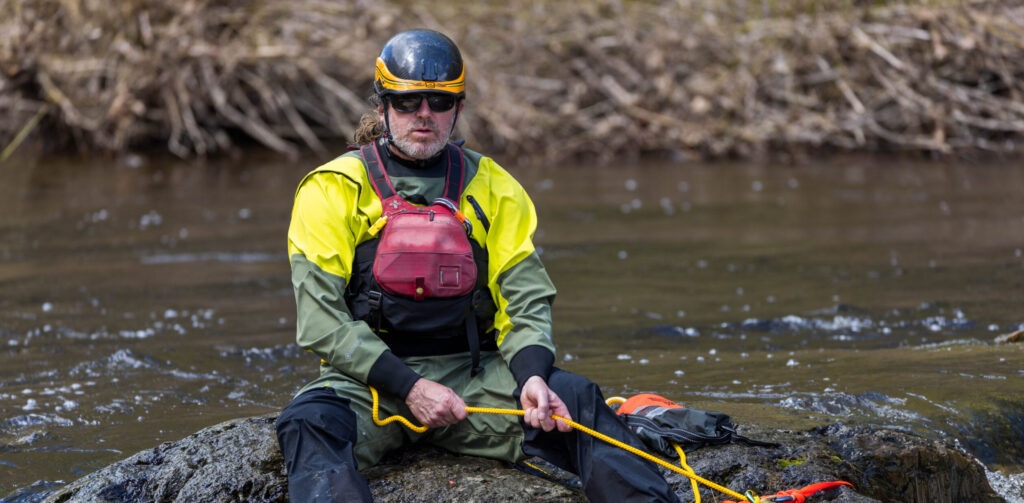
For Darron Laughland, swiftwater rescue instruction isn’t just a curriculum. It’s a calling shaped by loss, mentorship, and two decades on the rivers of the White Mountains.
Each year, through his companies, Sawyer River Group and SRG Rescue, he runs courses for college outing clubs, local search and rescue volunteers, recreational paddlers, and river guides. As a full-time high school teacher, he has also brought several classes of students through Level 3 training, covering unpinning canoes, swimming, wading, throw ropes and rope systems, and introductory raft and canoe paddling.

“The students gain essential skills, and the ripple effect of that knowledge and awareness spreads throughout our community,” Darron says.
Alongside his ACA teaching, Darron instructs volunteer and professional fire rescue personnel using a curriculum aligned with National Fire Protection Association standards for swiftwater and flood rescue. Moving between these two worlds — recreational paddlers and professional responders — has sharpened his sense of purpose. “Working with students who have different goals and operating conditions has deepened my understanding of why we perform rescue skills the way we do,” he explains, “and more importantly, how to approach prevention, decision-making, and risk management during an incident.”
Most of Darron’s courses run in and around the Mount Washington Valley in New Hampshire’s White Mountains, with additional courses in Maine and Vermont.
From Boy Scout Canoe Trips to a Black Pyranha Acrobat
Darron’s paddling roots go back to Boy Scout canoe trips and rafting in the Adirondacks. His parents coached a Girl Scout canoe race team that competed for decades in the General Clinton Regatta, and family camping trips regularly included canoe day trips. In college, he took a whitewater kayak course with ACA Instructor Steve Busch and a canoeing course with Laurie Guillion, author of the ACA Canoe Instructor Manual — then bought his first solo boat, a Dagger Rival.
Training on the Hudson Gorge with Whitewater Challengers led to a season of guiding, and in 1999, Darron bought his own kayak, a black Pyranha Acrobat 270. “I pushed rubber a few days a week and really learned to kayak that year,” he says, “and it has been sweet love ever since.” While guiding on the Moose River in Old Forge, he took his first ACA swiftwater rescue course with Charlie Walbridge — an experience he credits with making him a better, and above all safer, river guide and paddler.
A Path Set by Loss
Darron moved to New Hampshire in 2003 and stepped up his paddling amid the region’s renowned creeking. But his path toward teaching swiftwater rescue was set in 2006, when his paddling partner Cliff Eisner drowned on the East Branch of the Saco River at high water, likely from a strainer and flush drowning. Compounded by seeing multiple tourist fatalities on the Swift River — and rescuers turning away paddlers who tried to help — the losses pushed Darron to build greater skill and find ways to put it to use for others.
He helped found the White Mountain Swiftwater Rescue Team, modeled on established volunteer search and rescue teams in New Hampshire, and reached out to local fire departments, NH Fish and Game, and area liveries to bring the team together. That outreach led him to a swiftwater rescue course hosted by a local fire department, where instructor Ben Selleck — the state’s swiftwater and flood program instruction coordinator — invited him to the dryland session, then the full course. By the end of the weekend, Darron was helping teach the rafting portion, and he soon began training to teach swiftwater rescue at the state fire academy.
Ben became one of Darron’s two most influential mentors, introducing him to ACA Swiftwater Rescue Instructor Trainer Educator Mike Mather — the other. Mike later mentored Darron through the ACA instructor process, and last year Darron became an ACA Advanced Swiftwater Rescue Instructor.
Tributaries of Knowledge
Between rescue courses, Darron has spent summers teaching whitewater kayaking and canoeing and guiding rafts. He describes the knowledge passed down by ACA instructors as tributaries joining his own journey — each confluence renewing his teaching. He recently completed a canoe instructor course with Ben Morton, and is eager to bring that renewed passion to his students.
What’s Next
Darron’s current project is growing SRG Rescue, a new company building on Sawyer River Group that will offer swiftwater instruction for agencies and search and rescue teams, wilderness first aid, and — now — ACA canoeing instruction. He also continues working to bridge the recreational paddling community with agency rescue teams, building relationships that improve response to moving water incidents and flooding.
“The American Canoe Association curriculum and instructors set a high standard for instructional excellence, and it is humbling to be recognized amongst esteemed peers,” Darron says. “I look forward to continuing my journey as an instructor to share the knowledge others have so generously shared with me, to honor those our community has lost, and work to grow the skills, decision making, and humility needed to make paddlers safer as we enjoy our amazing sport and the beautiful places we paddle.”