


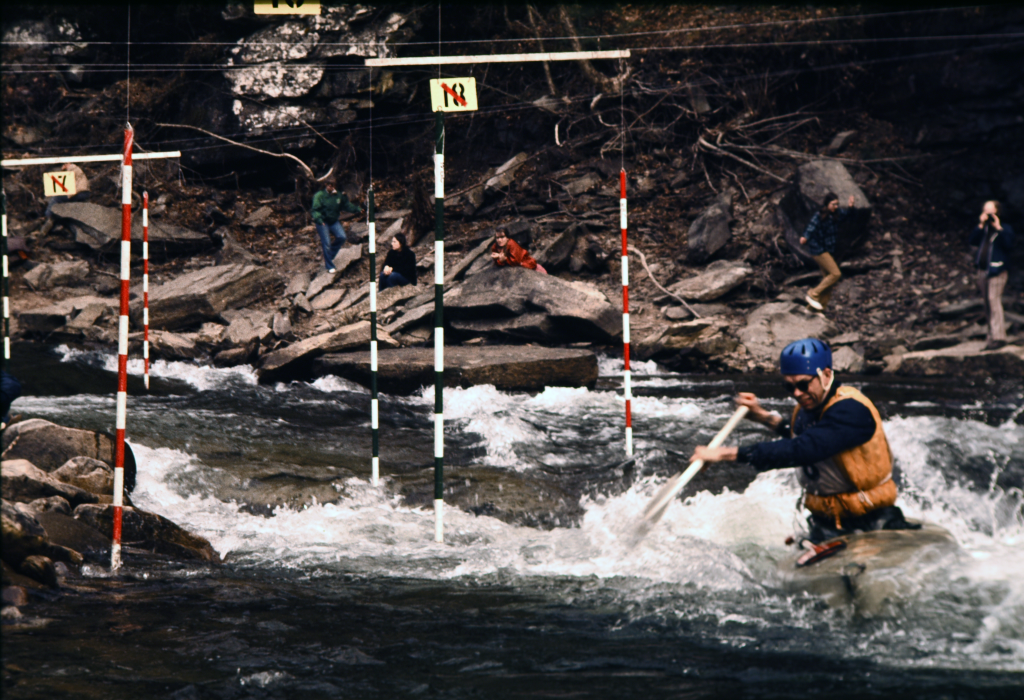
John entering an eddy on his off-side in his Sweet Hahn in the 1973 Loyalsock race. Photo Credit: Robert Kauffman
Many a whitewater boat was born in John Sweet’s garage. In the 1970s, if you wanted a whitewater closed canoe or kayak, you had to build it. There were a couple of commercial manufacturers, but they too were in their infancy and their quality wasn’t too great. John had a cottage industry selling by the yard woven fiberglass and nylon cloth to boat builders. He raced in Europe, where he brought back the latest race boat. The boat became a plug that was used to create a mold. Many a boat popped out of a mold in his garage. In what became known as the Penn State layup, John’s typical hull layup was Nylon, Glass, Glass, Nylon. It wasn’t supposed to work well, but John knew his materials. The layup created a rigid hull that held its shape, yet if you hit a rock, it was flexible… at least most of the time.
A hard-core paddler, you knew John was when entering his house. The walls were naked, greyish-white plaster walls. Neither paint nor wallpaper adorned the walls. However, decorating the living room walls were 15-minute topographic maps of the region.
John was into the racing scene, and so were we. Petersburg, Loyalsock, Bellefonte, and Yough were some of our races. For the Yough race, we bushwhacked through the dense rhododendron at Dartmouth Rapids on the Loop to hang the slalom gates. It was at a Yough race where John came out of his boat, a very rare occurrence. He didn’t like to swim. Like a cat thrown into the water, he literally jumped on top of his Hahn C-1, where he attempted to sit on it so that every part of his body was out of the water. If a skyhook appeared for his rescue, he would have grabbed it with every fiber of his being.
In the early 1970s, the C-1 Hahn was a hot racing canoe. The Hahn had nubs on each end of the canoe making the ends higher than the center of the canoe. They changed the rules, and John eliminated the knobs on the end. Along with some other minor modifications, the Sweet Hahn was born. For a while, we all paddled Sweet Hahn’s.
During the winter, when snow covered everything, the Penn State Natatorium had two swimming pools, which the Penn State Outing Club (PSOC) used for practice. Compared to John, a world-class paddler, I started out as a novice paddler in these practice sessions. A decent Grumman canoe paddler, I graduated to a Hahn, which showed me I needed to improve my technique. In the highly responsive Hahn C-1, I would take a forward stroke and spin around in a circle. Meanwhile, John paddled up and down the pool lanes in a straight line with perfect control. Perplexed, I sat there in wonder, looking at the precision of his strokes. What was he doing that I wasn’t? In time, my technique improved, and I too was paddling with the same precision. For a while, I even held the record time for running the English Gate. That was before you could sneak gates with low-volume boats.
Who would have thought you could have a highly competitive slalom race in a swimming pool? We did, and John was at its forefront of this innovation with the Penn State Pool Slalom. We hung five gates in one of the Natatorium’s swimming pools, and he designed a race course which used the same gates multiple times in the race. The competitive races were another way to develop our paddling technique, which translated into our river-running skills.
On one high-water trip in the Cheat Canyon, we were like little ducklings following mother duck down the river. For our group of five or six paddlers, it was like playing crack the whip, where each successive boat was further out of alignment. After running the first rapids, John turned to us, and with a stern voice, he told us that at a lower level, the normal hydraulic, which at this level was an inconsequential wave, would have eaten all of us. We needed to follow his lead more closely. As best we could, we obeyed, but that was easier said than done since no matter what we did, we were still playing crack the whip as we followed Mother Duck down the river.
On the same trip, I was second behind John as we ran High Falls. The tongue of the water felt like descending a lengthy escalator. There wasn’t a ripple in the descending water. The further I descended, the larger the wave on the backside grew. What didn’t look too formidable at the top of the drop grew larger and larger the further we descended? At the bottom of the tongue stood an ominous ten-foot high wave, with water cresting back on itself like a large hand that wanted to toss you back down the wave to your demise. The wave may have been smaller than ten-feet high, but coming down the escalator, it looked huge. John hit the cresting water at the top of the wave and, in what looked like a quantum jump, the wave threw him six to seven feet to the side. It was amazing. He was there, and then he was somewhere else. I had no choice but to follow. Fortunately, I made it through the wave without incident. During my stay at Penn State, John introduced us to other rivers, including the Gauley, New, and Upper Yough.
Like most students, I left State College in 1974 and moved to northeastern Pennsylvania, where I took a university position. The Lehigh River became my home river. I still built canoes in my garage with materials bought from John’s cottage industry. I continued with my boating safety involvement, organizing the first River Safety Symposium in 1977. My direct contact with John diminished, and it was through others that I kept up with his activities.
Much to our surprise, John, a bachelor and hardcore paddler, got married in 1988, sold his house in State College, and became a gentleman farmer in Mustoe, Virginia. He built a warehouse there and continued his business until 2005, when he sold it to Davey Hearn. Today, whitewater boats are commercially available, and there is little need to birth boats in garages. However, for several years in the 1970s, when the whitewater sport was in its infancy, both whitewater boats and future boaters were born in John’s garage. It was a sweet-spot.
About the Author
Dr. Robert Kauffman is a lifetime ACA member who first joined in the 1970s and now serves on the ACA Board of Directors. A Professor Emeritus at Frostburg State University, he has spent his career advancing outdoor education, boating safety, and environmental stewardship.
This story is published as part of the 2026 ACA Story Project, a month-long collection of stories written by ACA members. Without opportunity, these stories wouldn’t exist. That’s what the ACA does. Through education, stewardship, competition, and club support, we create opportunities for paddlers of all abilities. Your gift helps write the next chapter. Help us raise $25,000 by December 1 for the next paddler, and the one after that.