

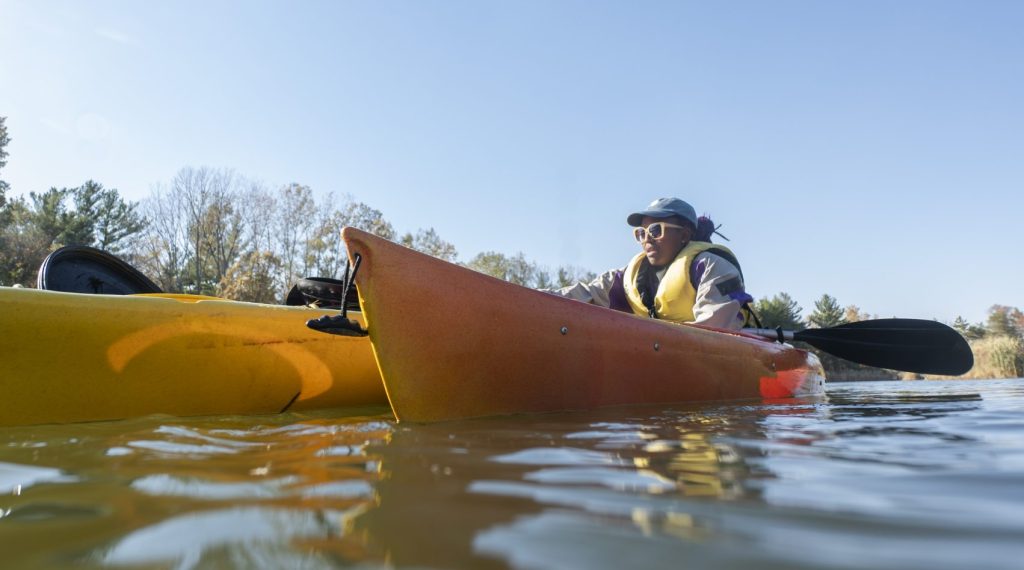
I didn’t grow up with generations of whitewater traditions or access to outdoor gear passed down from seasoned paddlers. What I did have was a mother who taught me the importance of water safety, a community in Virginia Beach that prioritized water sports, and enough yoga training to know what balance felt like. Thus, kayaking came naturally to me.
Even though I picked up recreational kayaking skills quickly, I’ve worked hard to learn the best ways to stay safe on the water long term. The more time I spend paddling, the more aware I become of the risks. No matter what kind of paddling I engage in—whether in a kayak or on a paddleboard—I’ve always understood that safety is not optional; it is fundamental.
I recognize that there’s privilege in my ability to say this. I imagine that not every new boater entering the sport later in life has access to mentors or safety networks.
Recently, I’ve been watching this sport change and expand in a good way. Now, more than ever, women and people of color (myself included!) are showing up on the water. I’ve especially noticed this in the D.C. area, where the Potomac and Anacostia Rivers are alive with new paddlers—particularly Black and brown folks who are claiming space in a sport that is still mostly white and male. Ironically, the Potomac River region is one of the most popular whitewater and sea kayaking destinations in the U.S., with one of the only Olympic slalom training areas located on public waters next to National Park land. We are surrounded by some of the most elite paddling infrastructure in the country—yet many recreational boaters don’t have access to even the most basic safety information.
People see how cool it looks to kayak, so they impulsively find a “sale boat” and get on the river with no consultation.
When I paddle the Potomac, I see people heading out on the river without life jackets, training, or a clear understanding of the risks. Just last month, a kayaking friend and I rescued a mother and daughter who were unaware of the danger high water conditions had created that day. They were attempting to taxi across moving waters, paddling without life jackets in boats that were too small for their size. While it’s easy to dismiss this as carelessness, as a community, we know that this narrative is not only harmful—it’s dangerous. The truth is that safety doesn’t come naturally. It is taught, shared, and modeled by those who care about this sport.
And for many BIPOC paddlers, especially those new to the sport, river and boating safety knowledge often isn’t accessible. The outdoor recreation world—and kayaking in particular—can be overwhelmingly white, sometimes conservative, and often unwelcoming. In that kind of environment, asking for help or admitting you don’t know something can feel intimidating, even unsafe. It’s not that people of color don’t care about safety—it’s that they may not feel empowered to access it.
As kayaking enthusiasts, it is in our best interest to help keep each other safe. As kayaking instructors, it is our responsibility to teach people how to be safe—at all costs.
Seasoned paddlers—especially in whitewater and sea kayaking circles—hold deep knowledge and awareness. They know what kind of gear can save a life, how to read the water, and how to assist a boater in distress. But are we sharing that knowledge beyond our own kayaking circles?
We need to approach paddlers in cheap Amazon gear with curiosity and care—just like any other paddler. This is a call to action for the paddling community.
Kayaking is not an elite club. If we care about the sport, we must care about people at every experience level. If we want more people to fall in love with paddling—and stick with it—we must make sure they feel included, welcomed, and safe. It is not enough for us to stay in our silos of experience while others navigate the water without the knowledge or tools to stay safe.
Thank you to Adrianne Burke for contributing her powerful story to the ACA Story Project. Her call to action challenges us all—especially instructors and experienced paddlers—to share safety knowledge more widely and welcome every paddler with curiosity and care.
About the Author
Adrianne Burke is a kayaking and yoga instructor based in the Washington, D.C. area. She first joined the American Canoe Association in 2022 while participating in the ACA LEAD Program in Iowa and has since blended her passions for paddling, mindfulness, and advocacy into a powerful teaching approach. She is an ACA-certified Essentials of Kayak Touring Instructor, Community Paddlesports Leader, and Paddlesports Safety Facilitator in canoe, kayak, and stand up paddleboarding (SUP). She is currently part of the second cohort of the Outdoor Alliance Grasstops Collective, a national leadership and advocacy development program that equips community leaders to champion conservation and outdoor recreation priorities at the federal level.