

Though I grew up canoeing on the Potomac River near my childhood home in Maryland, I never really learned how to paddle until the 2019 ACA Instructor Trainer (IT) Conference.
It was a deliciously warm October day in Richmond, Virginia, and I’d convinced Wayne Douchkoff, an ACA-certified canoe and kayak instructor, to paddle with me. I was one of the only non-instructors present. As we hauled the rental canoe to the put-in on the James River, Wayne shared that he’d paddled in all 50 states as well as in every territory in Canada. That was my first hint this was not going to be a relaxing paddle. My second hint came when Wayne observed me placing my phone in a Ziploc bag.
“That’s not going to be much help if we capsize.”
“Are we planning to capsize?” I retorted.
“That’s not the point.” He shook his head like I’d committed an egregious sin and reached into his own perfectly organized backpack. “Here,” he said, handing me two different waterproof nylon dry bags. “Wrap your phone and whatever else you’re taking in the smaller green bag, and then wrap the larger blue bag around it.”
I did as instructed and was then advised to re-wrap it, leaving some air in it so it would float if we did in fact capsize.
Wayne suggested a safer way to enter the canoe and questioned how I held the paddle in relation to the boat. Did I really know which side was the power face? How about trying to open the angle of my paddle to 45 degrees? Now move it to 90 and feel the difference.
From the way I gripped my paddle to how I sliced the water, Wayne dissected every move. I needed to rotate my torso more and fully submerge my blade.
“Are you lifting the water or pushing the water?” he asked. Apparently, there was a difference.
But when I tried to articulate a half-decent answer, he responded, “Do you know that every time you speak, you stop paddling?”
Before I could lament all the words coming at me fast and furious, Wayne changed his approach: he invited me to sit backwards so I could watch him demonstrate. Soon I was performing the cross-bow draw and ferrying across the river.
Elated to have made so much progress, I returned to shore thinking I’d spend the rest of the day working from my hostel room. After all, I’d traveled to Richmond primarily to attend the ACA Members Meeting taking place a couple of days later. But Wayne insisted I attend the IT classroom sessions with Kent Ford, Ben Lowry, and Charlie MacArthur. The following day’s workshops with Kelsey Bracewell, Anna Levesque, and Beth Wiegandt were also highlights. No one told me I didn’t belong, and I began to wonder if maybe I too could join their ranks as an instructor.
Two years later, during the first wave of post-COVID classes, I did just that.
Thank you, Wayne, my ITs Jordan Taylor, Bob Myron, and Beth Wiegandt—as well as all the other ITs at that conference! Your work makes a difference.
The ACA extends heartfelt thanks to Loren Edelson for sharing her story with the ACA Story Project and for her continued dedication to safe, inclusive paddling. From her first paddle strokes on the Potomac to her leadership as an instructor and conservation advocate, Loren’s journey reminds us how one experience on the water can shape a lifetime of impact.
About the Author
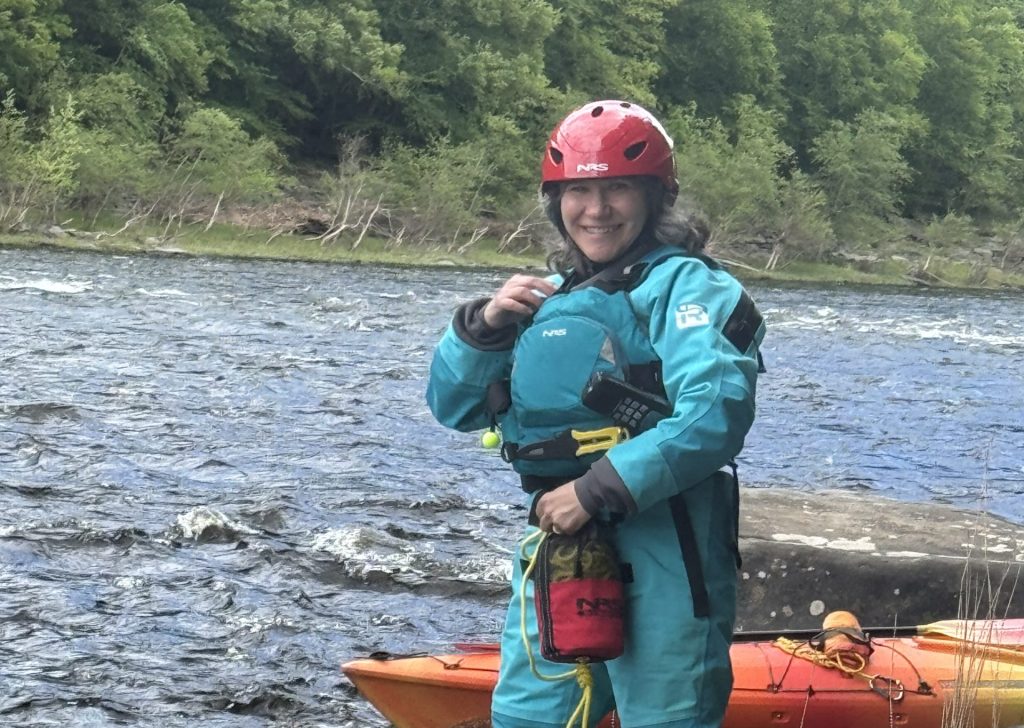
Loren Edelson has been an ACA member since 2015 and became an ACA-certified instructor in 2021. She holds certifications as a Level 2: Essentials of River Canoeing – Tandem Instructor and a Level 1: Introduction to Stand Up Paddling Instructor. From 2016 to 2020, she served as Director for Conservation and Public Policy for the ACA Atlantic Division, where she helped raise awareness around aquatic invasive species (AIS). The “Clean, Drain, Dry” poster her committee created is now featured at ACA Camp Sebago and neighboring Camp Nawakwa. Loren enjoys spending time on moving water as a trip leader with the Appalachian Mountain Club (AMC) and as a volunteer with the National Canoe Safety Patrol (NCSP).